
Orleans Parish Arrest Records and Charges
Arrest records in Orleans Parish are tied to the custody or law enforcement event. They may involve NOPD reports, OPSO booking data, LA VINE roster information, or court records after an arrest is followed by prosecution. The court charge record begins when a charge is filed in the proper court, such as Criminal District Court for most serious criminal matters or Municipal and Traffic Court for municipal misdemeanor and traffic cases.
The arrest record and the court charge record answer different questions. The arrest side asks who was taken into custody, when, and on what listed basis. The charge side asks what the prosecutor filed, what code or description was used, whether the charge was amended, dismissed, reduced, or carried forward, and what final disposition appears in court. For jail roster details, use the Orleans Parish inmate records page. For the full case file and sentence, use Orleans Parish criminal court records.
The NOPD police reports and public records page is the official city route for police reports and public-records requests tied to an arrest event.
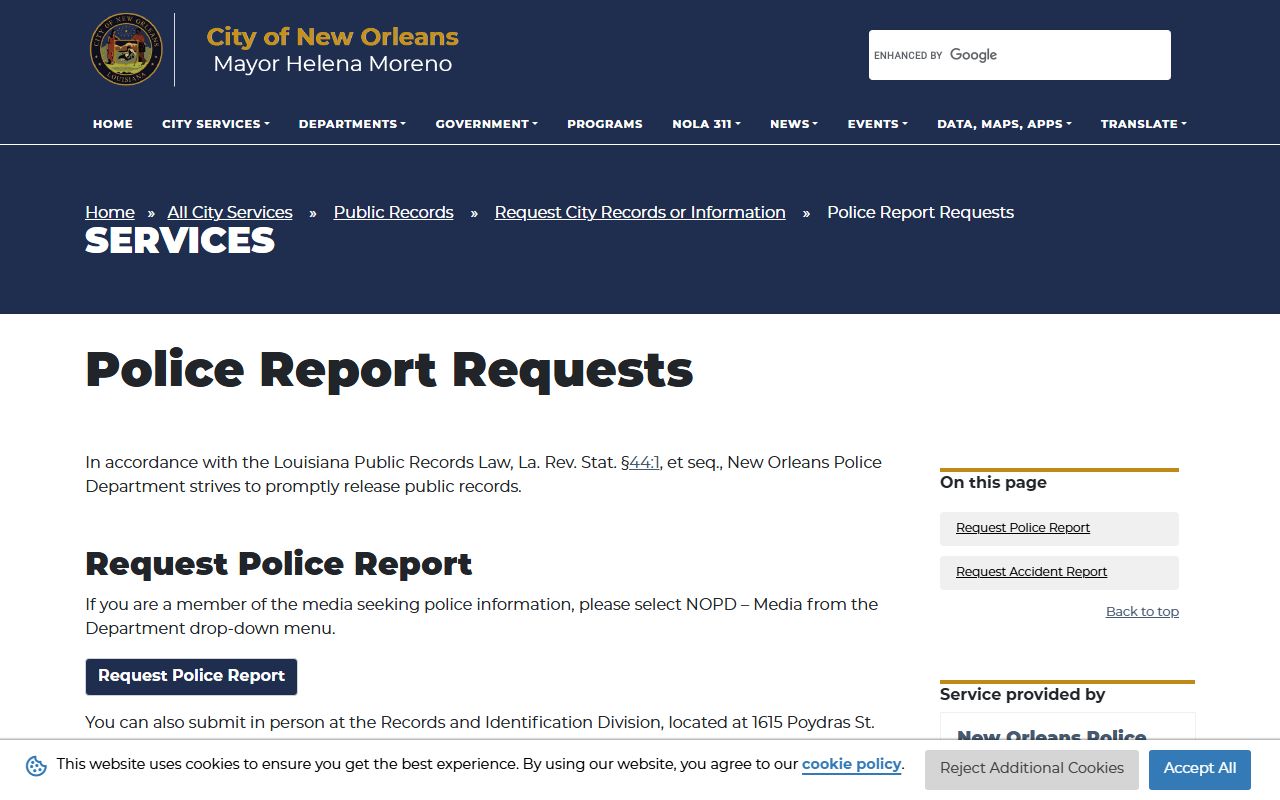
That source is useful for the arrest side, while the court clerk remains the source for filed charges and dispositions.
Find Orleans Parish Arrest Records
Begin with the record type. A recent custody question should start with OPSO detainee search or LA VINE, while a police report or accident report request may route through NOPD. A formal charge lookup belongs in the court where the charge was filed. Criminal District Court records route through the Clerk of Criminal District Court and Clerk Connect. Municipal and Traffic Court records use the traffic.nola.gov case portal or direct records request.
- Check custody status through OPSO or LA VINE when the question is whether a person is currently detained.
- Request police reports or public records through NOPD when the need is the law enforcement report.
- Search Municipal and Traffic Court by case number, name, or date of birth for city traffic or misdemeanor charges.
- Use the Criminal Clerk route for Criminal District Court charges, certified dispositions, and expungement records.
- Read the disposition before treating any filed charge as a conviction.
The NOPD online police report page shows the separate city channel for certain non-emergency report filings.
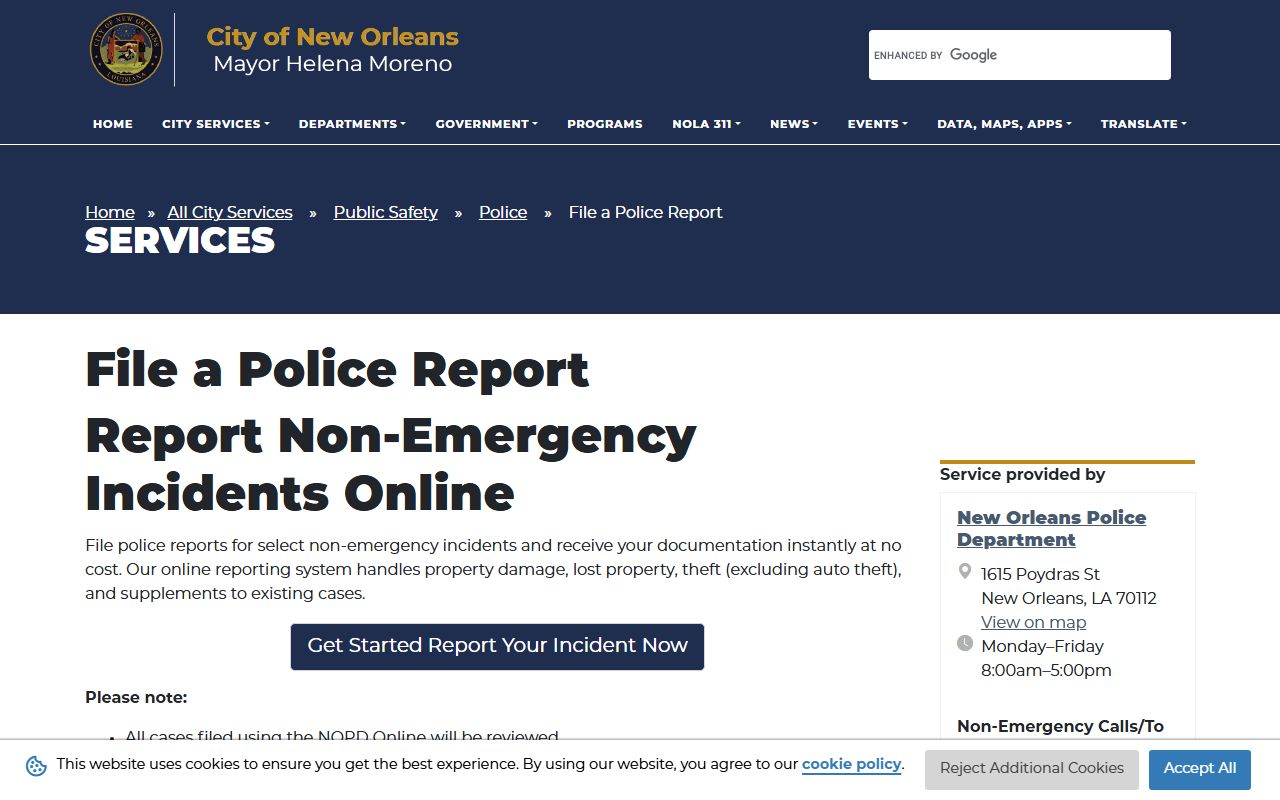
Police report channels may document the incident, but they do not replace a court case search for charges after arrest.
Orleans Charges After Arrest
After an arrest, the prosecutor decides whether to file formal charges. In Orleans Parish, the District Attorney is the prosecuting office for state criminal matters. A charging document is the record that starts or defines the court accusation. The most important point is that the booking charge seen in custody data may not match the final court charge, because the prosecutor can accept, reject, amend, reduce, or add charges.
| Document | Filed By | Common Use | What It Means |
|---|---|---|---|
| Complaint | Law enforcement or prosecutor depending on venue | Initial allegation or lower-level case start | Places the accusation into a court or screening path. |
| Bill of Information | Prosecutor | Many Louisiana criminal prosecutions | Lists the formal charge filed by the District Attorney. |
| Indictment | Grand jury | Serious felony matters | Shows that a grand jury returned formal charges. |
The Orleans Parish District Attorney Adult Pre-Trial Diversion page explains one way a case may be reviewed for an alternative to prosecution.
Diversion is part of the prosecution path, not a promise that an arrest record or court charge disappears.
Orleans Arrest Charge Status
Charge status tells what happened to a filed accusation. A charge can remain pending, be amended to a different statute or description, be reduced, be dropped, be dismissed, or end in a plea, verdict, or sentence. Municipal attachments, fugitive holds, contempt entries, probation violations, and court-order arrest entries may appear in custody or docket data, but each should be checked against the court file.
| Status | What It Means |
|---|---|
| Pending | The charge has not reached a final disposition in the court record. |
| Amended | The prosecutor or court record changed the charge wording, statute, level, or count. |
| Reduced | The charge was lowered to a less serious offense or different count. |
| Dismissed | The court record shows the charge did not proceed to conviction. |
| Nolle Prosequi | The prosecutor declined to continue that charge. |
| Convicted | The record shows guilt by plea, verdict, or other qualifying disposition. |
Orleans Charge vs Conviction
A charge and a conviction are not the same. Orleans Parish arrest records and court charge records may show an accusation long before a final outcome exists. A person can be arrested and never charged, charged and later dismissed, charged with one offense and convicted of another, or convicted and later seek expungement if eligible under Louisiana law.
| Charge | Conviction | |
|---|---|---|
| Point in Case | Early accusation after arrest or court filing | Final or later court outcome |
| Who Creates It | Prosecutor, grand jury, or court filing process | Judge, jury verdict, or plea accepted by the court |
| Can Change | Yes, it may be amended, reduced, or dismissed | Can be appealed, corrected, or expunged if eligible |
| How to Verify | Read the charging document and status | Read the disposition and sentence entries |
Orleans Charge Codes
Custody and charge records may use statute numbers, short charge descriptions, bond fields, arrest dates, and warrant or attachment labels. OPSO and LA VINE data can show custody-related fields such as name, booking or jail identifier, race, sex or gender, date of birth, arrest date, charge code, charge description, bond, and victim notification links. The research did not verify a public mugshot or release-location field, so those details should not be assumed.
One arrest can produce several charges. Each charge can have its own bond amount, status, disposition, and sentence. A municipal attachment after failure to appear is different from a new conviction. A fugitive or probation entry may point to another court action. Read the current court file before drawing conclusions from a roster line.
Sealed Orleans Charge Records
Louisiana law treats expungement as removal from public access, not destruction of the record. La. C.Cr.P. art. 971 states that expunged records remain available to law enforcement and other defined agencies. La. C.Cr.P. art. 978 addresses felony arrest and conviction expungement eligibility. La. C.Cr.P. art. 983 says expungement costs generally cannot exceed $550, subject to exceptions.
| Sealed | Expunged | |
|---|---|---|
| Public Access | Restricted by law or court order. | Removed from public access after the order. |
| Record Exists | Yes, but access is limited. | Yes, it is not destroyed under Louisiana law. |
| Who May See It | Court, agencies, or authorized persons. | Law enforcement and other defined agencies. |
| Orleans Filing Route | The court that holds the record. | Criminal District Court or Municipal and Traffic Court depending on the case. |
The Louisiana expungement findings statute is the starting point for understanding public access after expungement.
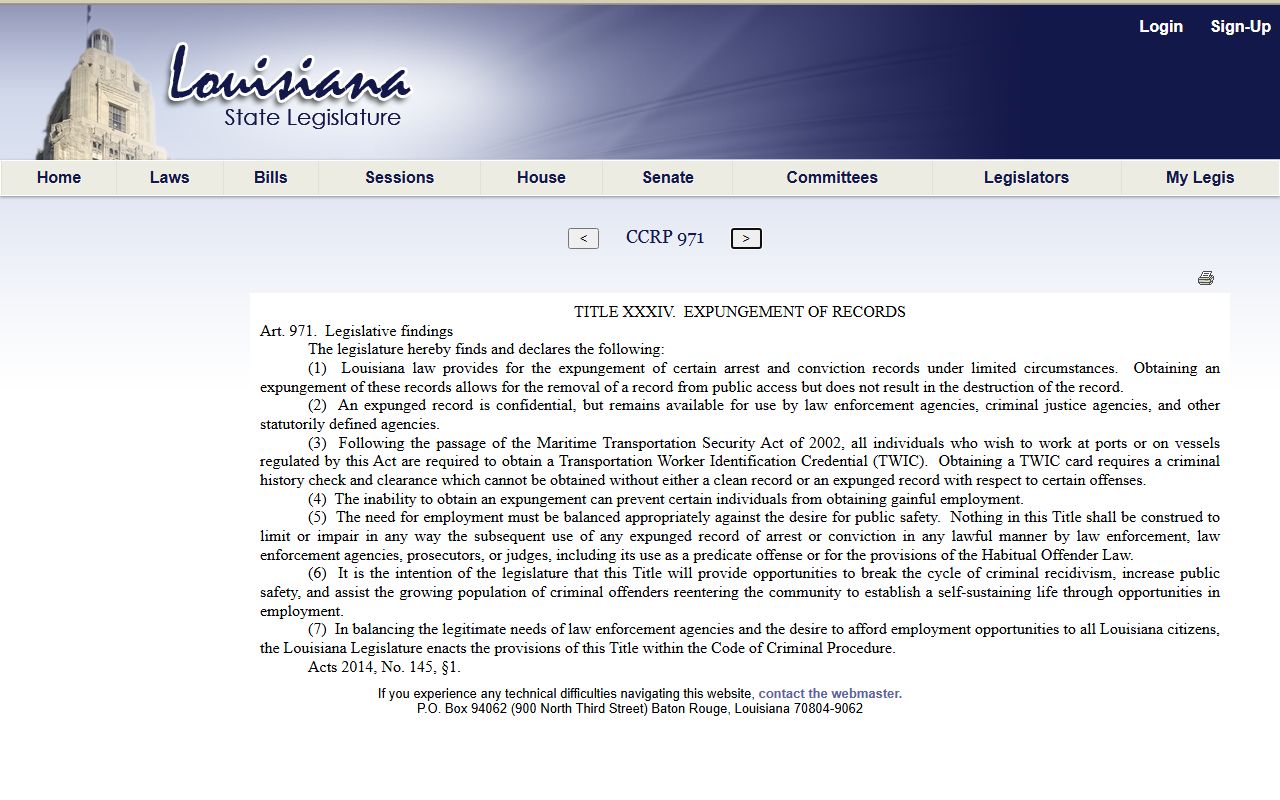
That statute keeps the page grounded in Louisiana's rule that expungement limits public view but does not erase the record from all agency use.
DA and Public Defender Roles
The Orleans Parish District Attorney is the prosecuting office that decides whether and how many state criminal charges to file. The DA contact page lists the main office at 619 South White Street and connects the office to appeals, child support, juvenile, and diversion functions. The DA's Adult Pre-Trial Diversion Program is voluntary and reviewed case by case; it is not the same as expungement or sealing.
Orleans Public Defenders is the public defense office for Orleans Parish. The OPD contact page lists 2601 Tulane Avenue, Suite 700, phone (504) 821-8101, and the state public defender District 41 page gives office hours Monday-Friday 8:30 a.m.-4:30 p.m. The public defender role is case defense, not clerk record certification.
Restricted Orleans Arrest Records
Some Orleans Parish arrest records and charge records are not open public records. Juvenile records are governed by the Louisiana Children's Code. Sealed or expunged adult records are restricted by court order and statute. Adoption-related, mental health, incapacity, personal identifier, and active investigative records may also be withheld or redacted. A public search result should not be treated as a complete criminal history.
The Louisiana felony expungement eligibility statute explains exclusions and eligibility rules for felony arrest or conviction records.
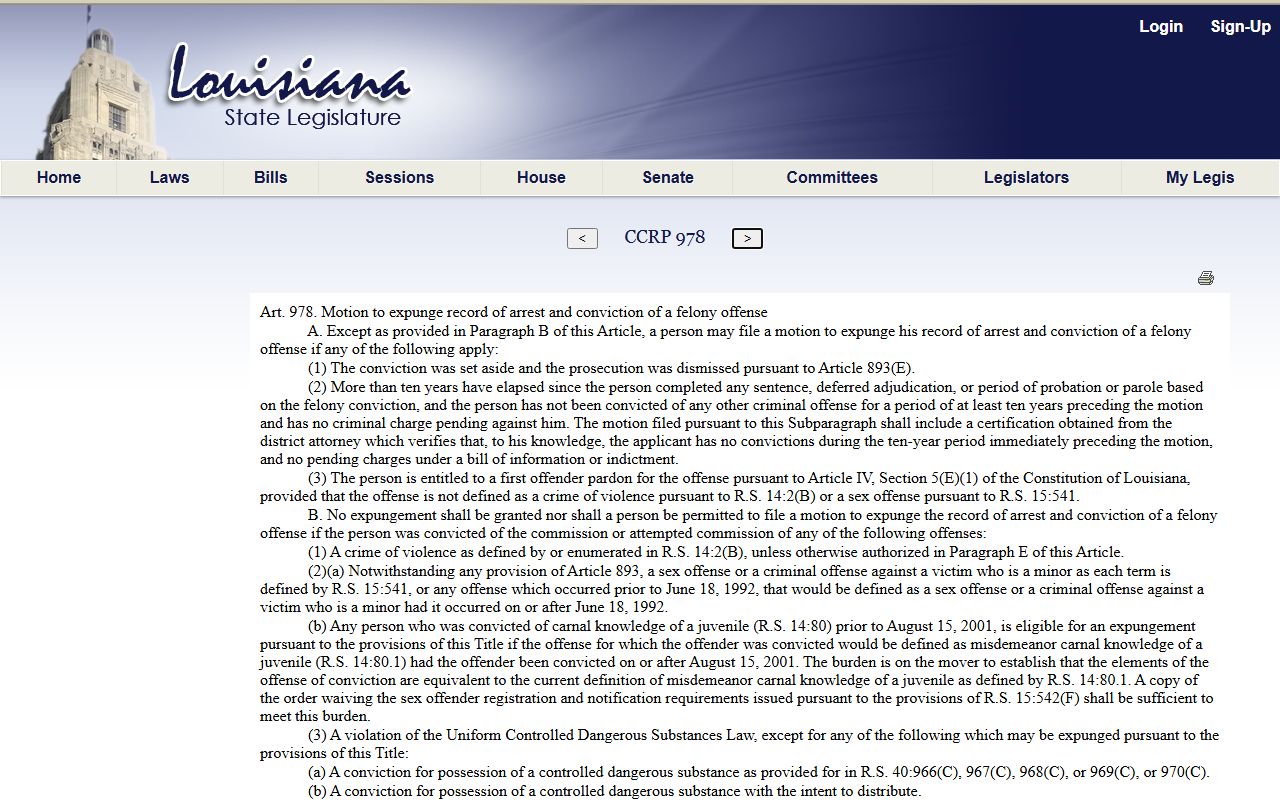
Eligibility must be checked against the exact arrest, charge, disposition, and statute, not just a short charge label.
The Louisiana expungement cost statute addresses the general cost cap and fee allocation for expungement orders.
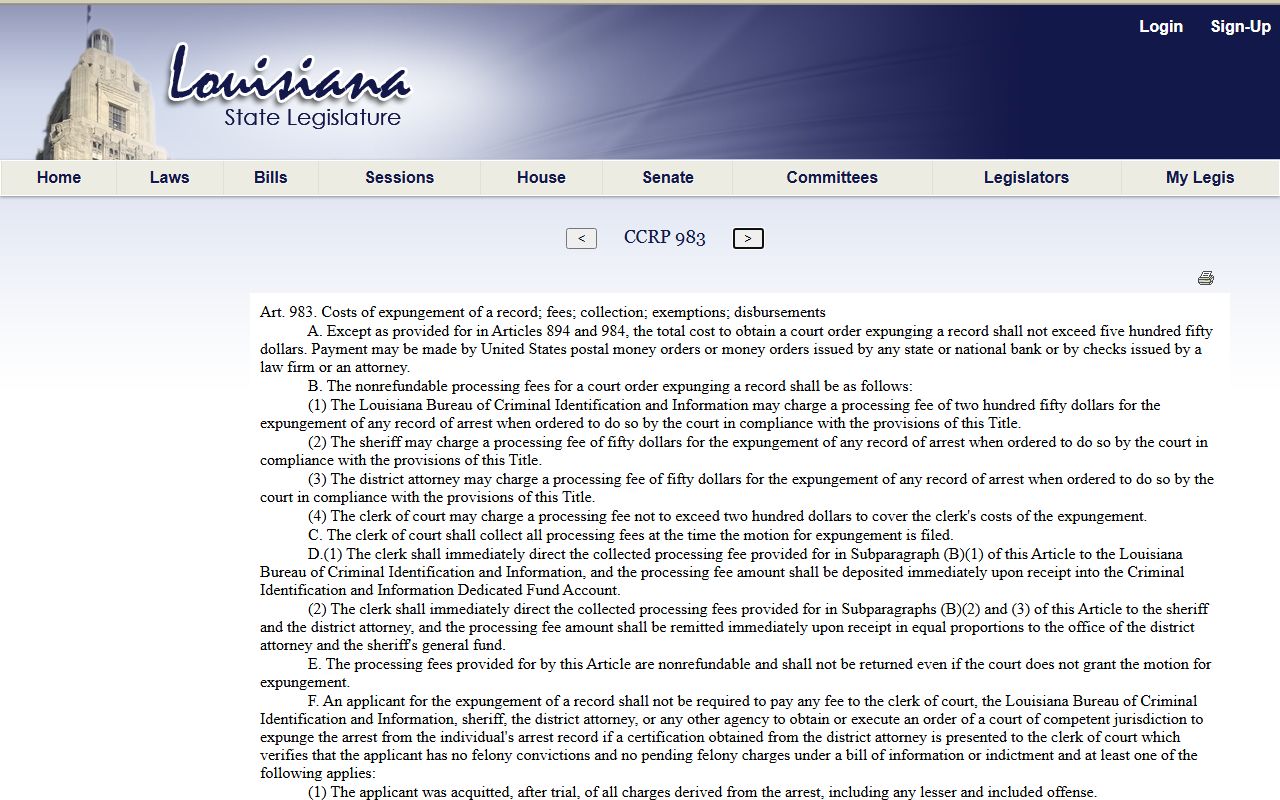
Cost rules matter because an expungement filing is a court process, separate from a casual arrest records lookup.